Contact: John Bloedorn or Nate Caroon 919-286-4837 (info@cravenallengallery.com)
(Above images)
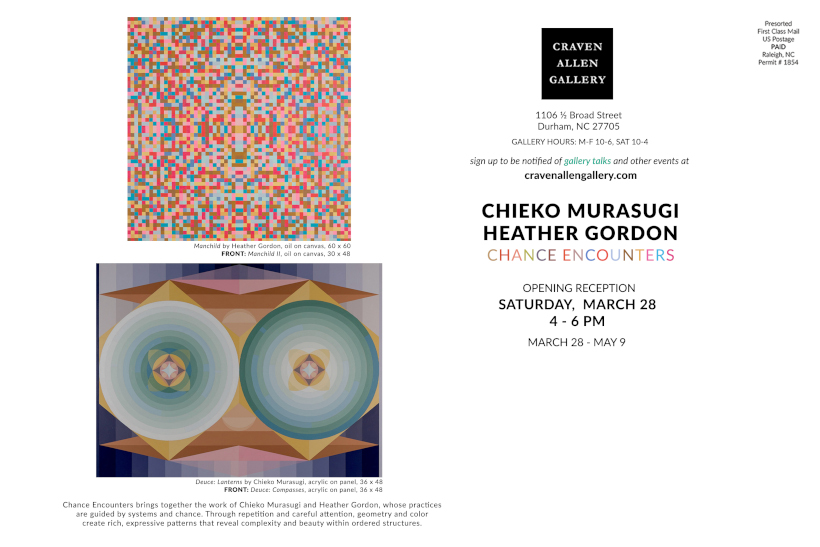
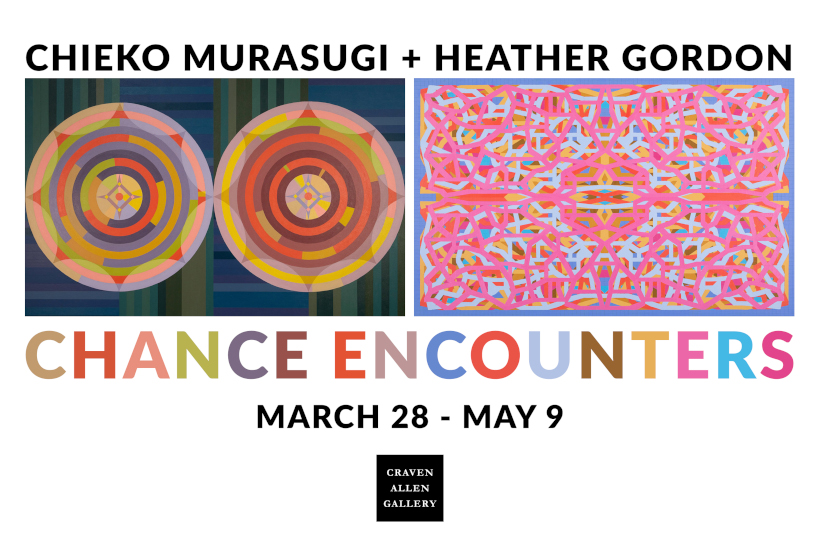
Deuce: Compasses by Chieko Murasugi, acrylic on panel, 36 x 48
Manchild II by Heather Gordon, oil on canvas, 30 x 48
Chieko Murasugi + Heather Gordon
Chance Encounters
March 28 – May 9
Durham — Chieko Murasugi and Heather Gordon Chance Encounters opens at Craven Allen Gallery on Saturday, March 28th with a reception from 4-6pm, and continues through May 9th.
Chance Encounters brings together the work of Chieko Murasugi and Heather Gordon. At first glance, their compositions appear as vibrant, dynamic abstractions, yet each piece is shaped by chance within carefully constructed visual systems. Working with structured frameworks and precise materials—acrylic on panel for Murasugi and oil on canvas for Gordon—both artists balance intuition and method, allowing rhythm, variation, and complexity to emerge over time.
Chieko Murasugi is a multidisciplinary artist whose work is shaped by personal history and perception. Born in Tokyo, raised in Toronto, and now based in Chapel Hill, she traces her fascination with chance to her parents, both survivors of the 1945 Tokyo bombings—her mother’s quick decision to run toward the river saved her life. Murasugi’s newest series, Deuce, uses computer-based randomization to guide composition and color. Each piece features two large circles that share ground but never touch, creating a tension that evokes distance, division, and the challenge of connection. “I was thinking about the United States,” Murasugi explains, “a country broadly divided into left and right, two sides with very different beliefs that struggle to communicate with one another.”
Heather Gordon constructs her paintings and drawings through constraint-based systems that combine mirrored grids, mathematical relationships, and predetermined rules. She establishes compositional fields and then introduces controlled chance operations to shape the distribution and application of color. Working in oil on canvas and ink on paper, Gordon creates layered visual fields where structure and chance interact, allowing balance and complexity to develop over time. Together, Murasugi and Gordon explore the tension between chance and method, intuition and system, presenting abstraction as both a visual and intellectual experience.
Craven Allen Gallery is located at 1106 ½ Broad Street in Durham. Gallery hours are from 10 a.m. to 6 p.m. Monday through Friday, and 10 a.m. to 4 p.m. on Saturday. For more information, please call the gallery at 919-286-4837 or visit www.cravenallengallery.com.
ABOUT CHIEKO MURASUGI
Chieko Murasugi was born in Tokyo to a mathematician father and artist mother, and immigrated to Canada with her family when she was three years old. Growing up in Toronto, she studied Social Psychology (BA, McGill U) and Visual Arts (BFA, York U) before earning a doctorate in Experimental Psychology, specializing in Visual Perception (PhD, York U). She was awarded an NSERC Postdoctoral Fellowship to conduct visual neuroscience research on monkeys at Stanford University. After publishing several scientific papers, she began an independent painting practice in San Francisco while raising two children with her neurophysiologist husband.
She moved to the NC Triangle in 2012. In 2019, she received an MFA in Studio Art from UNC-CH, and co-founded BASEMENT, an artist-run experimental project space in Chapel Hill. Chieko has exhibited her paintings and mixed media works widely in galleries and museums, including Greenhill, and the Ackland, Wiregrass, Weatherspoon, and Mint Museums. Her paintings can be found in public and corporate collections, such as Duke University, City of Raleigh, TIAA, and Honeywell. Chieko is the recipient of Wildacres, Black Mount College and Art Center (digital), and Hambidge residences, as well as an Ella Fountain Pratt Emerging Artists Grant and grants from the Orange County Arts Commission and the NC Arts Council. Her art practice is featured in Liza Roberts’ 2022 book, “Art of the State: Celebrating the Visual Art of North Carolina.”
HEATHER GORDON STATEMENT
My work grows out of a long-term investigation into structure, repetition, and the role of chance within tightly defined systems. I build visual frameworks using mirrored grids, mathematical relationships, and predetermined rules that allow complex relationships to emerge from simple constraints. Rather than composing intuitively from a blank surface, I construct environments in which order reveals itself through rhythm, probability, and interaction.
Early projects centered on palindromic forms and symmetrical inversions. Over time, this inquiry shifted toward emergence. This shift focuses on how coherence develops without hierarchy or central control. I establish systems that contain their own internal logic and then allow variation, repetition, and chance to guide each work toward its final form. Across both my paintings and drawings, I am interested in how many parts can exist together without dominance, how balance forms through interaction, and how complexity grows from simple relationships. The work functions less as an image and more as a field. It operates as a distributed structure in which no single element takes precedence.
Materially, I work primarily in oil on canvas for paintings and ink on paper for drawings. These media allow both precision and accumulation, supporting layered systems that unfold slowly over time. A central ongoing question in my practice is how color operates within these structures. It functions not as decoration, but as an emotional and experiential force shaped by adjacency, memory, and perception.
Rather than arriving at a fixed aesthetic, I approach the studio as a site of continual testing and discovery, where structure becomes an environment for lived experience and where order and chance continually shape one another.
ABOUT HEATHER GORDON
Heather Gordon is a North Carolina-based artist who makes paintings and drawings rooted in structure, pattern, and chance. She lives and works in Knightdale (NC), where her studio practice centers on building visual systems that slowly unfold through repetition and constraint.
Much of Gordon’s work grows out of an early familiarity with problem-solving and systems thinking, developed through growing up around analytical work and structured environments. That way of thinking continues to inform how she approaches relationships, balance, and how complex forms can emerge from simple rules. She often describes her paintings as a kind of mapping that traces interactions, rhythms, and fields of connection rather than physical places.
Her work has been exhibited widely across the Southeast and throughout the United States, in museums, contemporary art centers, and site-specific public contexts. She has also developed interdisciplinary, time-based collaborations with choreographer Justin Tornow that translate her two-dimensional systems into spatial and performative environments through movement and sound.
Her work continues to evolve through sustained studio practice, research, and interdisciplinary exchange.